An Online Reflection of Cuba

Havana coastline photo: Caridad
HAVANA TIMES — I was sitting with a group of friends
(students and teachers) on the grass at the former Institute of Sciences
and Nuclear Technologies (today INSTEC), at Havana’s old “Finca de los
Molinos” estate.” This was at the end of 2008.
Out of the blue, one of the guys there remarked, “I’m writing for the
website of an American who lives in Cuba.” I remembered reeling back
dumfounded by that contradictory comment: An American?
in Cuba?
The words immediately brought to my mind a conspiratorial backdrop that
smacked of geopolitical confrontation, espionage and ideologies
hopelessly at odds.
“This American works at ESTI (the Cuban translation agency),” he
explained. “The website began not very long ago. The guy’s pulling
together a team where each person will write a blog.” That made it both
clearer and stranger at the same time. To cap it off, he added, “The
group of bloggers should have the same number of men as women. A gender
balance thing.”
The name Circles Robinson isn’t very well known in Cuba, but he’s the
editor of one of the most popular online news sites on Cuba that has
hit the web. It’s the burgeoning
Havana Times online
publication, administered today from another ALBA country (Nicaragua).
These writings are reaching an ever wider audience in Cuba, by on-line
connection for the few or by e-mail for the rest.
It is an online medium where diaries of ordinary Cubans coexist with
rigorous reports from correspondents with the Cuban-accredited Inter
Press Service agency (IPS), as well as with analytical articles and the
opinions of recognized experts; it also publishes interviews and
excellent photographs.
Sharing a Deeper Look at Cuba
This project of Circles Robinson succeeds, perhaps without intending
to, in sharing with non-Cubans an in-depth vision of Cuba: our
“Cuba profunda.” When
we walk down the street or look out our windows, we’re usually able to
perceive the countless details that served as inspiration for people
like Don Fernando, Lezama, Dulce Maria, Oscar Hurtado or Victor Fowler
in their multiple inquiries about the experiential spirituality of our
country.
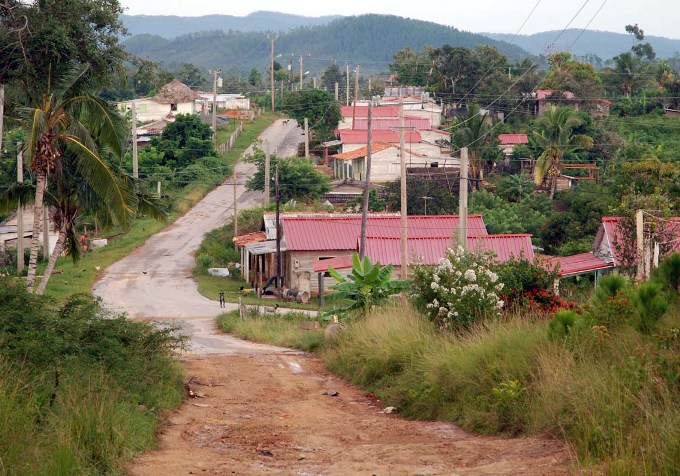
Viñales, Pinar del Rio. Photo: Caridad
And what can one say about the symbols that fill our minds? For me, the exceptional merit of
Havana Times
is that it allows people from other countries to share in the signs and
symbols of current “Cubania” without these being denigrated as
“folkloric” or converted into “
pasto para turistas” (tourist fodder).
Clearly this is only the personal opinion of a regular contributor to
the publication, but I can bear witness: my own perception of “me and
my circumstances” in Cuba has been attaining greater clarity since I
began writing for the site. Through writings and photographs,
Havana Times
graphically reveals a Cuba that is neither hell nor heaven, though
certainly a place where it’s possible to live and share one’s life.
It’s an Internet site whose main characters are, for the most part,
people “like everybody else”: workers, students, self-employed,
professionals, artists and writers. The
Havana Times
collective is like a family. Its subtitle in English, “Open-minded
writing from Cuba,” means just that. Having an open mind is to distance
oneself from the same old boring monotones that have been so justly
criticized, as well as from tiresome polarized aggressiveness… It’s an
invitation to dialogue in a Cuba where many Cubas fit.
A palpably uncomfortable journalism
Despite this, the site has never tried to duck controversy. In a
recent polemical post, a leftist blogger (from the group “Bloggers
Cuba”) compared Robinson to none less than Charles Dana, the editor of
the New York newspaper that published Marx and Marti. Perhaps it’s an
exaggerated praise, but let’s remember too that bloggers suspicious of
anyone who promotes questioning and divergent thinking abound on the
Cuban web.
Havana Times is a formidable source of information and
debate that has covered subjects ranging from a (failed) expedition to
the biggest garbage dump in the Cuban capital, to incidents related to a
professor who lost his job in a conflict with the administration, the
complex problems of transgenic crop cultivation, domestic violence and
the life of the imprisoned “Cuban Five” in the United States.
It is a type of journalism that’s uncomfortable for many, generated
by people who for the most part are not trained as journalists (and
among these “amateurs,” by the way, is the editor himself).
However, speaking of “uncomfortable journalism” – isn’t that what many of us want, for the good of Cuba? Because of that,
Havana Times
has started to become a part of Cuban reality, part of the complex
processes of change that are now occurring. It’s one of those X rays
machines with which our society — finally! — can look at its insides.
Filled with a desire to unravel the “intrigue” shrouding the subject
in question (“Who is Circles Robinson?”), I requested an interview from
him, aware of how controversial this would be. Circles, who is already a
friend of many of us, kindly agreed to allow me to share this dialogue
in the pages of
Espacio Laical, a publication of the Catholic Church of Cuba. At this point, we’ll ask him to speak in his own words:
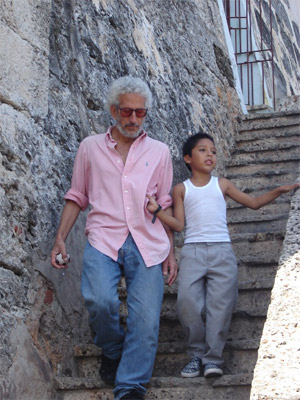
Circles Robinson in Cojimar with his grandson Axel Karim.
Who is Circles Robinson and how did you come to live in Cuba? What was your occupation on the island before starting up Havana Times?
Generations ago my family were immigrants to the United States from
Rumania and Russia at the beginning of the 20th century, and I was born
and raised in Los Angeles. However the formative experiences of my life
took place very distant from that atmosphere: in a small town in the
old US West and in Latin America, where I’ve spent most of my adult
life.
Since 1982 I’ve lived outside of my country — in Spain, Nicaragua and
Cuba — working in everything from agriculture, cooperatives and
tourism, to international relations and translation, but with a
recurrent link to journalism and small publications.
My interest in Latin America began when I left the US for the first
time, in 1972, dodging the military draft during the Vietnam War. In
Colombia, where I lived for two years, I became somewhat aware of the
effect of US policy on the continent. This culminated with my sensing —
albeit from a distance — the repercussions of the military coup in
Chile against Allende on September 11, 1973.
I also experienced the Colombian people’s warmth, the value they
placed on family, their stories and mysteries, and the food. From all
this came my preference for living in Latin America.
Ultimately I won in the draft lottery, a sort of sinister Bingo-like
drawing that the US Army employed for recruiting youths into its war
machine. At that time the service was obligatory, but some of the men
would never have to serve due to their numbers in the lottery being too
high. I was one of them, so I could return to the United States, which
I did in 1974, without having to wait for the amnesty given by Carter
in 1977.
I went to live in a small town, Bisbee, Arizona, previously a copper
mining town on the Mexican border. There I worked for the local radio
station, published a newspaper, learned a little something about
typography and managed a small food cooperative. Local political
activism (and some degree of solidarity with the FMLN in El Salvador and
the FSLN in Nicaragua) characterized my years in this town as part of a
group that sought a “better world,” though on a smaller scale.
After leaving the US permanently in 1982, I first lived to the south
of Granada, Spain, working in agriculture and participating in a small
cooperative.
At the end of ‘84, in the face of threats by recently re-elected
president Ronald Reagan to invade Nicaragua, I decided to contribute my
grain of sand working in coffee plantations in that country, also as a
way to understand the Nicaraguan Revolution. I picked coffee with a
large brigade of “nica” teachers and another smaller contingent from a
Nicaraguan Christian base community.
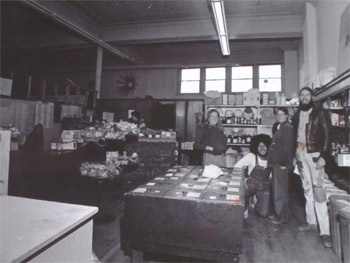
Circles, kneeling, when he managed the Bisbee, Arizona Food Co-op in 1976.
After 17 years in Nicaragua, experiencing the revolution and its
subsequent debacle (1990), I went to live in Cuba at the end of 2001. I
was hired by the Prensa Latina news agency as a translator/reviser of
their English service. From the beginning I established lots of
contacts with the journalists and I concerned myself with trying to make
the materials that I revised communicate a little more, a little
better, to the readers abroad.
Along with my wife, daughter and grandson, I lived in Tarara (on the
far eastside of Havana) because this was where PL offered housing for
its technicians at that time. It was a beautiful place right off the
beach, but it was also far from the city and that meant hours of daily
waiting for buses or hitchhiking.
At that time my wife worked as a volunteer for two “Transformation Workshops” (Spanish:
Talleres de Transformacion)
in the Havana neighborhoods of Atares and El Canal. My daughter
studied for a year at the National Art School (ENA) before beginning her
studies (paid for by us) at the faculty of Audiovisual
Media at the
Superior Institute of Art (ISA). My little grandson began his first
daycare center once he learned how to walk, a month after arriving in
Cuba. As a result of all this, I had the opportunity to become aware of
Cuban life from several perspectives.
In mid-2004 I accepted an offer to work in the same capacity for
other Cuban online media, but from a new office called On-line
Translation based out of the national translation/interpretation office
(ESTI). My family’s housing situation was decisive in that decision.
As such, we moved into an apartment recently vacated by another foreign
translator. It was located in Miramar near the Karl Marx Theater, and
half a block from my daughter’s university campus.
At ESTI, given our involvement with the Cuban press, the small staff
that worked for On-line Translation formed a chapter of the “Cuban
Journalists Association” (UPEC). I also began to write a personal blog
at the end of 2005, partly in response to a suggestion from UPEC to its
members.
In the following years I participated in the training of translators
and webmasters on how to improve their pages in English. I drafted a
report and presented it in meetings convened by the PCC for the staffs
of digital media organizations in different provinces. As a member of
UPEC and representing our chapter, I began to participate in meetings
that were convened annually for journalists of the written press.
Discussions around the deficiencies in the content and scope of the
Cuban press were constant among my close colleagues. In 2007 an
internal directive on the media was issued from the Politburo of the
Cuban Communist Party (PCC). Among other things it spoke of the need to
reflect the reality of the country in news reporting – something I
found highly encouraging and motivating.
I participated as a full delegate (with voting rights) in the UPEC
Congress in July 2008. The topic of how to improve the press was raised
there by numbers of people from the media, particularly the youth.
Nonetheless the discussions failed to produce any concrete changes, and
after leaving the conference we returned to the same old thing, the same
static routine – something that created only frustration for me.
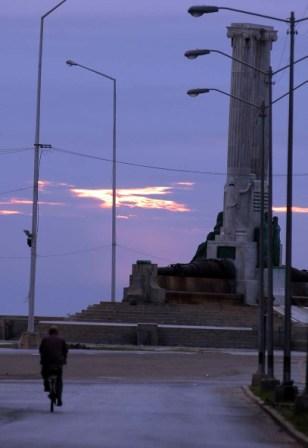
Havana sunrise. Photo: Caridad
How was Havana Times created?
A little later, I decided to begin a webpage as my contribution to
putting into practice the type of media that I thought — and still think
— should exist for the national public and for foreign readers
interested in Cuba. It was more than clear to me that the Cuban media
utterly failed to reflect the country’s daily life – in the streets, on
the job and in homes. Problems were practically absent, as were the
rich diversity of opinions on any issue.
I felt that my personal blog had reached its end, and I wanted to do something with more reach and involving more people.
Our motto in English
“Open-minded writing from Cuba” means “
Cuba sin prejuicios”
in Spanish. With so many media sources demonizing everything that has
to do with the Cuban Revolution and its leaders on the one hand, and the
monologue of the official Cuban media with its message that
“everything’s almost perfect in Cuba and the rest of the world is evil,”
on the other, there was a great need for a media that didn’t weigh in
from either of those extremes.
I already had several experiences in the field of publishing. I had
published a biweekly newspaper in the town where I lived in Arizona and
years later I published a monthly magazine in English for the main
farmer’s organization of Nicaragua. It was Nicaragua from a campesino
perspective.
But HT was not only my idea: two other people — a Cuban and an
African-American — have been indispensable parts of the creation and
continuation of the project from the beginning.
I owe a great deal of thanks to my family for the support that I’ve
received in financing the project. I’ve always thought that
self-financing would be the sole way to carry out the effort without
making it vulnerable to criticisms of being directly or indirectly
sustained by the omnipresent “enemy.” Fortunately, the costs of the
initiative are modest. That’s one of the big advantages of online
work.
Over a three month period we created the design, sought our initial
writers and began accumulating photos. We received HT’s banner photo
just a few days before going online. Start-up wasn’t easy because many
of the people we approached were working for government entities or
studying; and writing a for non-official Internet press entity isn’t
looked upon very well by many supervisors, professors and party
functionaries.
We opted for a simple but attractive design, with lots of photos –
that’s one of the strengths of HT. In the beginning the publication
only came out in English, focusing on non-Spanish-speaking readers
interested in Cuba, be it for tourism, study or whatever. This was
consistent with my job as a foreign technician working for the online
English language media in Cuba.
Among the goals was to present different situations experienced in
the country and the wide diversity of opinions, showing the beauty and
achievements as well as the blemishes and real problems. In short, we
were aiming to show the country in the flesh, a country like others but
different at the same time.
We launched into cyberspace in mid-October of 2008, and I took on the
challenge of working my regular day job with ESTI and publishing HT in
my free time. It was an exhausting pace involving 14-16 hour days
sitting in front of the computer. Also, though we had planned to
update the page once or twice a week, the site quickly evolved into a
daily online publication due to the quantity of material we received and
the speed made possible by technology.
Two months after its start-up we officially presented the site at the
UPEC headquarters before the directors of that organization and
representatives of a number of Cuban media.
Tell us how your previous experiences influenced the concept and style of your new online magazine?
There were many Cubans who experienced the collapse of the Soviet
Union and the socialist camp first hand while studying or undergoing
training in those countries. I myself didn’t experience Eastern Europe
first hand, but I did witness the painful collapse of the revolution in
Nicaragua. It was like seeing the closing of a great window of
opportunity — for creativity and for learning from other efforts, for
improving — all shut in a single motion. I still feel the pain even
today.
For me the Nicaraguan Revolution was like Cuba’s, another David vs.
Goliath story with great freshness and hope, but which gradually began
to extinguish.
The economic blockade that Nicaragua suffered, like Cuba, and the war
(also sponsored by the US) played a significant role. However for me
the reversal was due to the loss of revolutionary ethics, self-adulation
by the senior leadership, a triumphalist monologue, the lack of
controls and economic mismanagement, the lack of substantive
participation by the people in decision making, plus the gradual
distancing of the leadership from the base and their believing
themselves to be eternally in power, all of which led to the crushing
electoral debacle of February 25, 1990.
After the hurricanes. Photo: Caridad
After that disaster I stayed, working seven more years for the
campesino organization UNAG, the counterpart to Cuba’s ANAP and which
included the cooperative movement. During that time I, like many other
people, tried to figure out what had happened, still dreaming of another
chance to transform the world into something different…where people,
social justice, collective well-being and nature were more important
than capital, and where people would reflect on their errors instead of
repeating them.
Going to Cuba a decade later was an opportunity for me to see how it
might have been if Nicaragua’s revolution has lasted 40 years instead of
just 10… what would have been its achievements, its strengths as well
as its problems and weak points? Nicaragua was not a copy of Cuba but
it was influenced by its big brother in many aspects.
By living in
Cuba I realized how much the Nicaraguan Revolution meant to Cubans at a
personal level, for each individual. What had happened was very painful
for them too.
With respect to the media, I remember that Salman Rushdie in his book on Nicaragua (
The Jaguar Smile) wrote that the Sandinista party’s newspaper (
Barricada) was the worst he’d ever seen.
At that time — finding myself in the middle of the war and accepting
the leaders’ arguments concerning the need to restrict information and
criticism for the sake of unity — I didn’t agree with anything Rushdie
said. Later I did come to concur with him. It was in fact a terrible
newspaper that minimized the capacity of people to assess information
and to reach their own conclusions.
In Cuba I found a fascinating country with major achievements as a
society but one with enormous cumulative problems. The investment that
had been made over half a century to promote culture was evident, and
being in the capital I was able to enjoy the fruits of those advances.
Collectively, the press, radio and TV were something altogether different though. It was a return to the
Barricada.
What I found in the Cuban media was that same monologue: asserting
possession of the absolute truth while omitting information, misusing
statistics and claiming a false unity, not to mention the constant
stream of triumphalism. In short, what current president Raul Castro
describes as “the boring press.”
We wanted to do something different with HT, something where ordinary
people had a voice, not only leaders and recognized intellectuals. We
also intended to include the work of experienced journalists and
photographers along with reports and commentaries.
The goal has been to reflect the range of realities and challenges
faced in the country. Hence, our “diaries” section was born. In this
section are the personal logs of our bloggers, who come from a wide
variety of fields and have an equally broad range of opinions and
beliefs/ideologies.
How is Havana Times different from other similar media? And what do they share?
I don’t think there’s really anything similar with the great majority
of the young writers living in Cuba. Perhaps the closest things in
format are
Cubaencuentro and
Diario de Cuba.
Although technically we’re just one more of the thousand-plus websites
written about Cuba, we opted from the beginning for a format that was
more like an online newspaper, and this has worked for us.
At one single site we have the voices of 15 people writing their
blogs in the first person; in addition there are reports, commentaries
and photo features by veterans as well as novices to the trade. We
also reproduce materials from the IPS news agency, which has racked up
more than 30 years of reporting from Cuba.
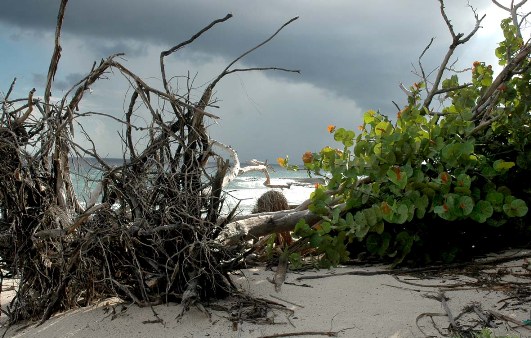
Photo by Caridad.
With respect to the content, I believe that several elements
distinguish us: the diversity of opinions and styles, ranging from
intellectual analyses to very simple and direct styles; our not being
rigid extremists and not being the mouthpiece of any party,
organization, institution or movement.
We cover and comment on issues
concerning the economy as well as sports, culture etc. It’s simply a
publication that looks for ways to elevate the knowledge about and
interest in Cuba and attempts to be accessible to a board spectrum of
national and foreign readers.
Is there any contradiction
between your previous occupations and the creation of this new
information medium? Has your appreciation of the situation on the
island changed since starting Havana Times?
On the contrary, having translated and revised for the Cuban media
for seven years gave me many ideas about how journalism here could move
forward over time. Translating and revising journalistic materials can
be extremely boring when the materials are of little interest,
repetitive, missing information and are oblivious to what the most
casual observer can see all around. But it also gives you a lot to
think about in terms of how you would write, including your topics and
style.
Moreover, I had already put out other publications and ran two radio
programs without being a certified professional. To succeed with HT, I
drew on all my experiences. One thing I’ve learned how to do, and that I
love to do, is involve more and more people, almost creating a family,
and this is how it feels with the
Havana Times group. We even have readers who also feel like they’re part of the project – and they are.
My appreciation of the situation concerning the Cuban media hasn’t
changed. There have been timid efforts to present aspects of the
different realities of the country and its people. There’s been some
talk about certain problems, but it’s all been well below what’s
required. Likewise, absent are focuses and opinions that diverge from
official policies. They’re either nonexistent or so shy that they don’t
come to mean real change. Real debate remains absent.
Furthermore, the lack of investigative journalism has done a great
deal of harm to the country. I’m sure that if this type of journalism
had been encouraged, rather than repressed, some of the major cases of
corruption would have come to light much, much earlier. This lack of
investigative reporting makes business executives and authorities feel
like they’re on a throne, unquestionable and untouchable!
Who make up Havana Times?
Havana Times is a fluctuating number of 20-25 people that
include writers, translators, the webmaster and me – the editor. The
overwhelming majority of the group are Cubans who live on the island.
They’re of all ages, though most are between 30 and 45. However we also
have a couple of Cuban writers who live abroad, in addition to three US
citizens, all of whom possess depths of experience after having lived
in Latin America and worked for governments in countries that have
undergone revolutions.
Photo: Caridad
One of the things that I insist on with those who write their diaries
is the importance of their own voice, their perceptions, their
experiences. This “I” exists in
Havana Times, and that’s of
interest to the readers. When we meet as a group every six months, we
can appreciate the diversity of people who make up the collective.
The
mixture of professions, jobs, abilities, backgrounds, gender, race,
community activism experience and beliefs, etc. is evident. A few
guests always show up at these meetings and even to them this diversity
is palpable.
The writing also demonstrates this. There are people who write
about personal and practical problems, while others go into
philosophical matters; some deal with their neighborhoods, others touch
on economic and political questions that the country is facing; then
too, there are those who express concerns about social coexistence, and a
few like to relate anecdotes or tackle the international terrain, etc.
We only exclude those positions that use insults instead of arguments
to debate.
The topics that people choose to write about come from each of them
as individuals. I sometimes suggest an issue for an article or a photo
feature, but this doesn’t make up more than five percent of the
materials we publish.
Tell us about how the project has developed, how it has taken stands, or the surprises, conflicts and joy it has generated.
Three big changes happened the first year. The first one was our
losing the support of the UPEC leadership, which was initially offered
publically to
Havana Times. Ultimately, after seeing the
publication in practice over half a year, they couldn’t accept it as an
independent and critical medium, one in which there were young
non-journalists expressing themselves about their situations, their
realities so distinct from the picture painted by the official media.
The second change was when my contract wasn’t renewed in June 2009.
I’m convinced this action had its roots in an ethical conflict with my
boss, and that
Havana Times was not the principal reason.
However, the net result was the loss of my temporary residency and
therefore the need for my wife and I to leave the country within 30
days. I returned to Nicaragua, where I have legal residency. From
there I continued the magazine with visits to Cuba every six months.
However the greatest change for HT was the September 2009 decision to
put out a version in Spanish. This had been a constant request by the
bloggers so that they could share their work with other Cubans.
The effect has been remarkable and growing.
The Cuban readership
from the island was less than five percent the first year; now Cuba is
in first place position among our Spanish readers, making up 15 percent
of them. Following this are readers from Spain, the US, Mexico and
Venezuela. In English, Cuba is located in fourth place behind the US,
Canada and the United Kingdom. This doesn’t include the numbers of
people in Cuba without Internet connections who receive HT by e-mail.
The project has demonstrated slow but steady growth. We have a
modest average of around 2,000 visits to the site daily and 5,000 pages
visited. This is not an insignificant amount for a relatively new
publication that specializes in a single country.

Photo: Caridad
We’re building a varied readership, one of differing political
perspectives, but what unites the great majority is a healthy interest
or love for Cuba. They feel comfortable with the inclusive variety of
opinions that are read in HT, different from what can be found in the
hundreds of sites of apologetic cheerleaders or the many others set up
by venomous denigrators.
So is it an effort that is primarily for “yumas” (foreigners), or is it also for Cubans? Why do you think Cubans read Havana Times? Is there some special contribution and characteristic of Havana Times when it comes to events taking place in Cuba?
I believe that
Havana Times is playing a modest role in the
debate on the present and future of the country and also in the analysis
of its past. One of its fresh contributions is including ordinary
people with their diaries or personal blogs as a fundamental part of the
site.
There are intellectuals who would say that the level of writing is
uneven or not at their level, but we’re not seeking to be an academic
publication or one only for intellectuals. We’re cultivating the
general public, which includes them if they want, but they’re not the
only ones. I’d also dare say that everyone who is writing for the site
has improved their skills, their ability to express themselves and
their arguments.
As for the obvious question of language, we began by directing the
magazine toward the Anglophone world and to Cubans who understand
English, including many overseas. But now our readership is much more
varied and we have increasingly more readers in different countries of
Latin America, like Mexico and Venezuela.
One goal has been to remove the surprise factor for people planning
to visit Cuba in the future. We put both the achievements and the
problems on the table, providing certain knowledge to the readers so
that when they’re in Cuba they can deepen their attempt to understand a
complex and varied country. I would also say that later, many of these
people will find the nuanced Cuba that they discovered in the pages of
Havana Times.
For internal debate in Cuba, HT is playing a role like several other
sites, providing a setting for critical expression that practically
doesn’t exist in the official spaces. Obviously the big obstacle is
the very limited Internet access that Cubans have, but we’ve made a
beginning and the tendency is one of growth.
Havana Times has been the object of criticism from distinct political positions. How do you respond to those critics?
People with completely closed positions who believe themselves the
owners of absolute truth — both those of the supposed left and those on
the right — are bothered by the site and they have attacked us.
On the US side, on the right, the best example is a businessman from
Massachusetts who owns more than 2,000 Internet domains with Cuba,
Havana or other related keywords in their names. These were secured
with the idea of promoting his present and future business activities,
including sexual tourism. Since the very beginning he has maintained
that I’m a “high-level agent of Cuban State Security” and that we’re
“the Cuban government’s response to the famous dissident blogger Yoani
Sanchez.”
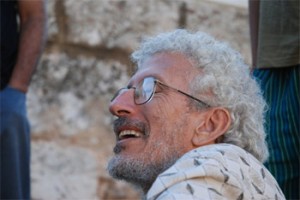
Photo: Caridad
At the same time, there are completely unquestioning groups of
apologists in Cuba and in solidarity groups abroad who take a dim view
of us. Some of them have told me that we are “playing the enemy’s game”
because we publish articles exposing the many difficulties and
widespread dissatisfaction in the country.
Some acquaintances and
colleagues of this thought have told me that the youth who complain
“should leave the country” instead of contributing criticism about the
government and its policies.
Is Circles Robinson “before” Havana Times the same person as “after”?
My appreciation of life has not changed with the experience of HT
though I feel a great warmth from the good friendships that have
developed through the project. We have lived on the razor’s edge,
ourselves being sharp hard critics but also constructive ones, hoping
for understanding from Cuban officials — who can cause problems for our
bloggers and even our readers in Cuba — if they don’t come to the
understanding that we’re part of the process of positive change within a
revolution that started 52 years ago.
I continue to hold onto the dream of being able to publish
Havana Times
from Cuba, like I did in the beginning. In that way I would have more
contact with those contributing to the site, as well as be in closer
touch with the country and even its authorities.
It might be a crazy
idea on my part, but I feel that there are those even in the party who
value positively our contribution to the Cuba trying to overcome this
stage of immobility, stagnation and deterioration, and replace it with a
new era, one of initiative, creativity, widespread participation and
progress with solidarity.